Fasteners that will not stay put
The recurring Tucson failure. A system with no surface penetrations does not have that maintenance cycle at all, which is most of what you are buying.
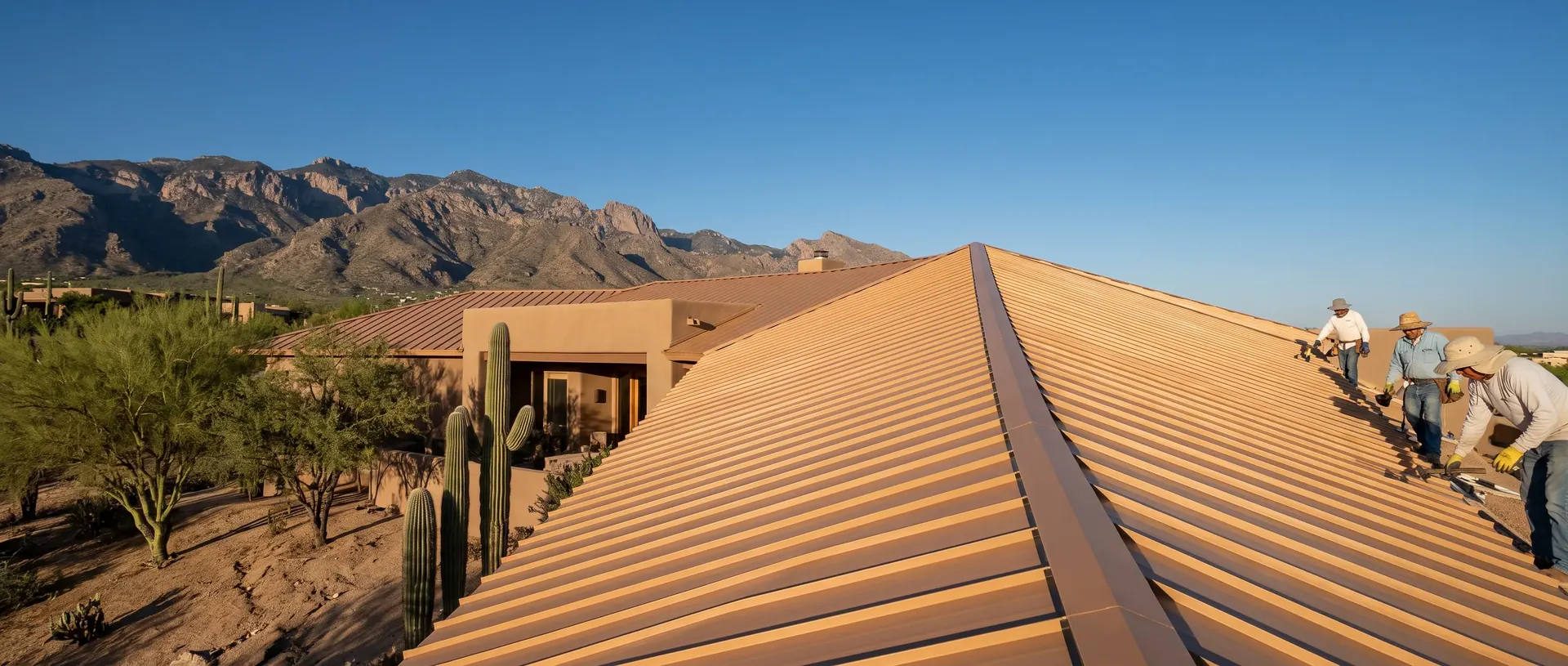
The system with no screws through the surface, which in a climate that moves metal every single day is the whole argument. Here is how it works and when it is worth the extra.
01Support service
There are two ways to hold a metal roof down. You can drive screws through the face of the panel into the deck, which is an exposed fastener roof. Or you can clip the panel to the deck underneath and fold the edges of adjacent panels together over the top, so the fasteners are hidden inside the seam and nothing penetrates the weather surface. That second one is standing seam.
In a mild climate that difference is mostly about looks and budget. In Tucson it is about physics.
A metal panel in this desert expands and contracts measurably between a July night and a July afternoon, and it does that every day of its life. An exposed fastener roof resists that movement, because every screw is pinning the panel in place. Something has to give, and what gives is the screw hole and the rubber washer.
Standing seam is designed the other way around. The clips let the panel slide as it grows and shrinks, so the daily movement is absorbed by the system instead of fighting it. There are no holes through the surface for the sun to attack and no washers to go hard and crack.
That is why we recommend it more often here than we would somewhere cooler, and it is also why it costs more. There is more material in it and considerably more labour.
We install metal roofs and nothing else. If exposed fastener is the better value on your building, we will say so.
02What this solves
The recurring Tucson failure. A system with no surface penetrations does not have that maintenance cycle at all, which is most of what you are buying.
Plenty of Tucson houses have long, low pitched planes where wind driven monsoon rain gets under a lap. A properly seamed standing seam roof handles low slope far better than a lapped panel does.
If the plan is to install a roof once and not manage it, this is the system that supports that plan. It is the expensive answer and it is the one that asks least of you afterwards.
03The first visit
Below a certain slope, an exposed fastener lapped panel is the wrong choice regardless of budget. That is a measurement, not an opinion.
Long unbroken runs move more and need more allowance. Foothills and Oro Valley houses often have long complicated planes, and that changes the detailing.
You get to see what standing seam actually costs against exposed fastener on your roof, rather than being told the expensive one is simply better.
Panel profile and gauge, clip type and spacing, underlayment, flashings, trim and exclusions. On paper.
04Our process
Pitch, run length, penetrations and details, then the panel profile and clip layout that suit them.
Profile, gauge, finish and colour. In this climate the coating is what has to survive, so the finish specification matters more than the shade. Lighter finishes reflect more and show chalking less.
Early starts in summer, off the roof around midday. No open tear off with a storm cell forecast.
Old roof off, deck checked and repaired where needed, then high temperature underlayment across the whole deck with extra membrane at the details.
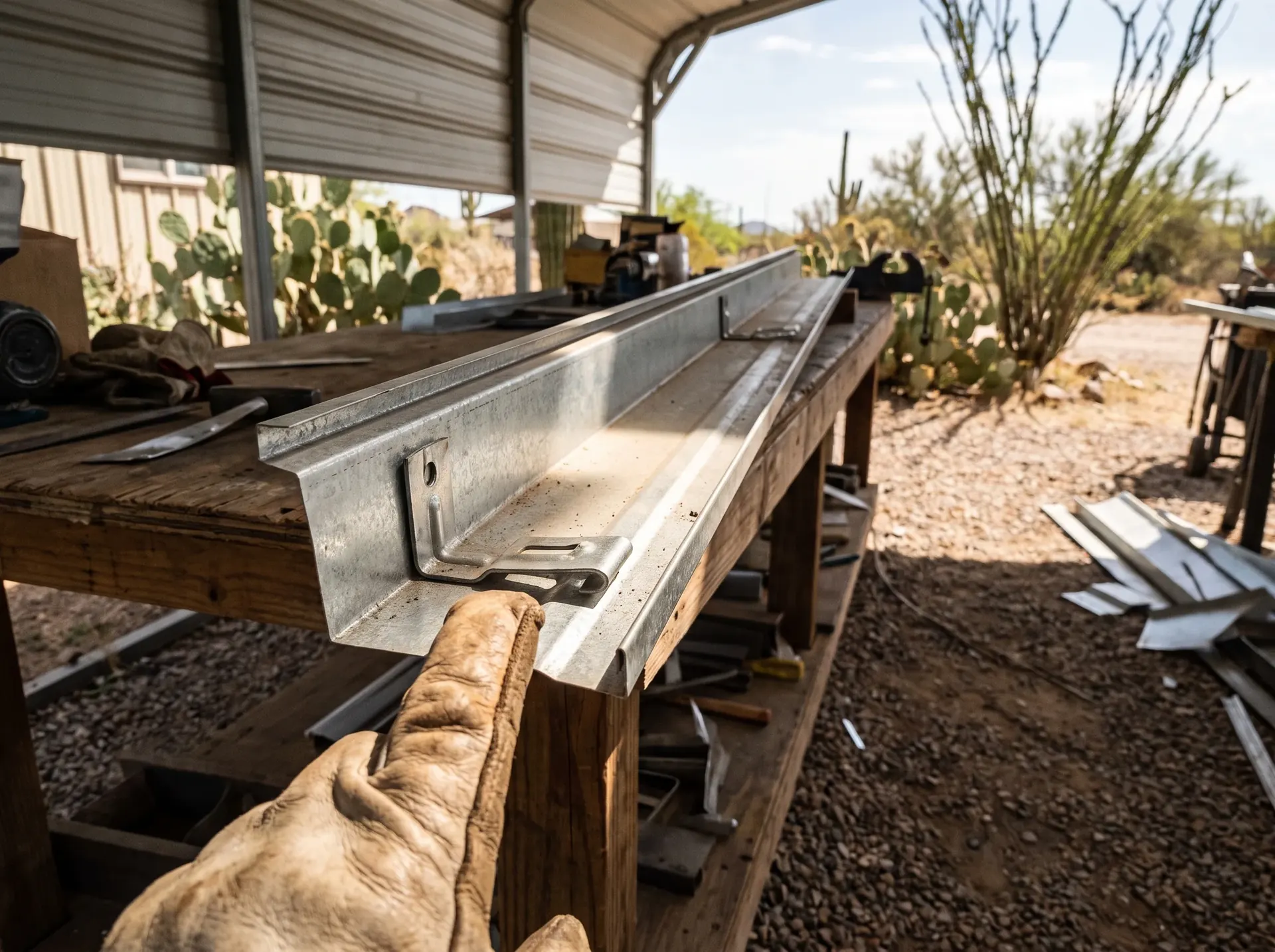
Clips fastened to the deck, panels set with the movement allowance the run length requires, seams closed. Panels are often formed to length so a long run has no end lap to leak.
Details formed on site, penetrations flashed properly rather than sealed over, then we walk it with you and clean up.
05Why us
Clip spacing, movement allowance, panel run length and seam mechanics are what this system lives or dies on. They are not something to work out on your roof.
On a small simple roof, or a detached shop, or a building you are not keeping, exposed fastener may be the better spend. You will hear that even though it is the cheaper job for us.
The entire point of the system is that the panel is allowed to move. Fastening it as though it should not is a common and expensive mistake, and it turns an expensive roof into an oil canned one.
Next step
We will measure the pitch and the runs, price both systems, and tell you which one your house actually needs.
06Proof
We would rather show you a roof than a quote from somebody you have never met. Ask us for an address in your area and go and look at it.
Ask for an address near you07Questions
Standing seam costs meaningfully more than exposed fastener because there is more metal in the panel, more hardware under it, and a great deal more labour in forming and closing the seams. The gap between the two on your roof depends on pitch, run length and how many details there are. We price both so you can see the actual difference rather than a general one.
Yes, up front, and by a wide margin. The argument for it is length of service and what happens in between. An asphalt roof in Tucson sun is often looking tired well before the number on the packet, and it will be replaced again. A standing seam roof is intended to be the last one on the house. Whether that trade works depends on how long you are staying, which is a question only you can answer.
Cost is the main one and it is a real barrier. It is also unforgiving of bad installation, because if the panels are not allowed to move you get oil canning, which is visible waviness across the flat of the panel, and it is very difficult to fix afterwards. Repairs and later penetrations are more involved than on a lapped panel roof. And it is a specialist install, so the pool of people who do it properly is smaller.
We are not going to name manufacturers, partly because it turns into a sales pitch and partly because the install matters more than the badge. What is worth asking about is the coating specification, the gauge of the metal, and the clip system, because those are what determine how the roof does in this sun. A good panel installed badly will fail before a modest panel installed properly.
For most Tucson houses, yes, and specifically because of the fastener problem. No penetrations through the weather surface means no screws to back out and no washers for the ultraviolet to destroy. Exposed fastener is not a bad system though. It is a great deal cheaper, it goes on faster, and on a shop, a barn or a simple outbuilding it can be exactly the right call.
Longer than the alternatives, and in this climate the honest limiting factor is usually the coating rather than the steel. A well specified and well installed standing seam roof is a decades long proposition. We are not going to attach a specific year count to it, because that depends on the panel, the finish, the exposure and whether anyone maintains it.
It helps for the same reason any light coloured metal roof does, which is reflectivity rather than the seam itself. What standing seam adds is that the assembly stays intact for longer, so whatever reflective performance you paid for is still there in fifteen years. See the heat post for the full explanation of what a metal roof does and does not do to the temperature in a Tucson house.
08Service areas
Tucson, Oro Valley, Marana and Vail, and everywhere between them. Sahuarita, Green Valley, the Catalina Foothills, Corona de Tucson, Catalina, Rita Ranch and Three Points.
Areas we serve08Related
09Get started
Tell us what the roof is doing. We will get on it, look properly, and put the answer in writing. If it does not need work yet, that is what the estimate will say.
Or call(520) 422-4745Mon to Fri, 6am to 3pm. Early hours are not a typo. Summer roofing here starts at first light and comes off the roof around midday.