Wind off the Catalina front
Stronger than the valley floor and consistently directional. It finds edges, trim and any panel end that was not fastened with that in mind.
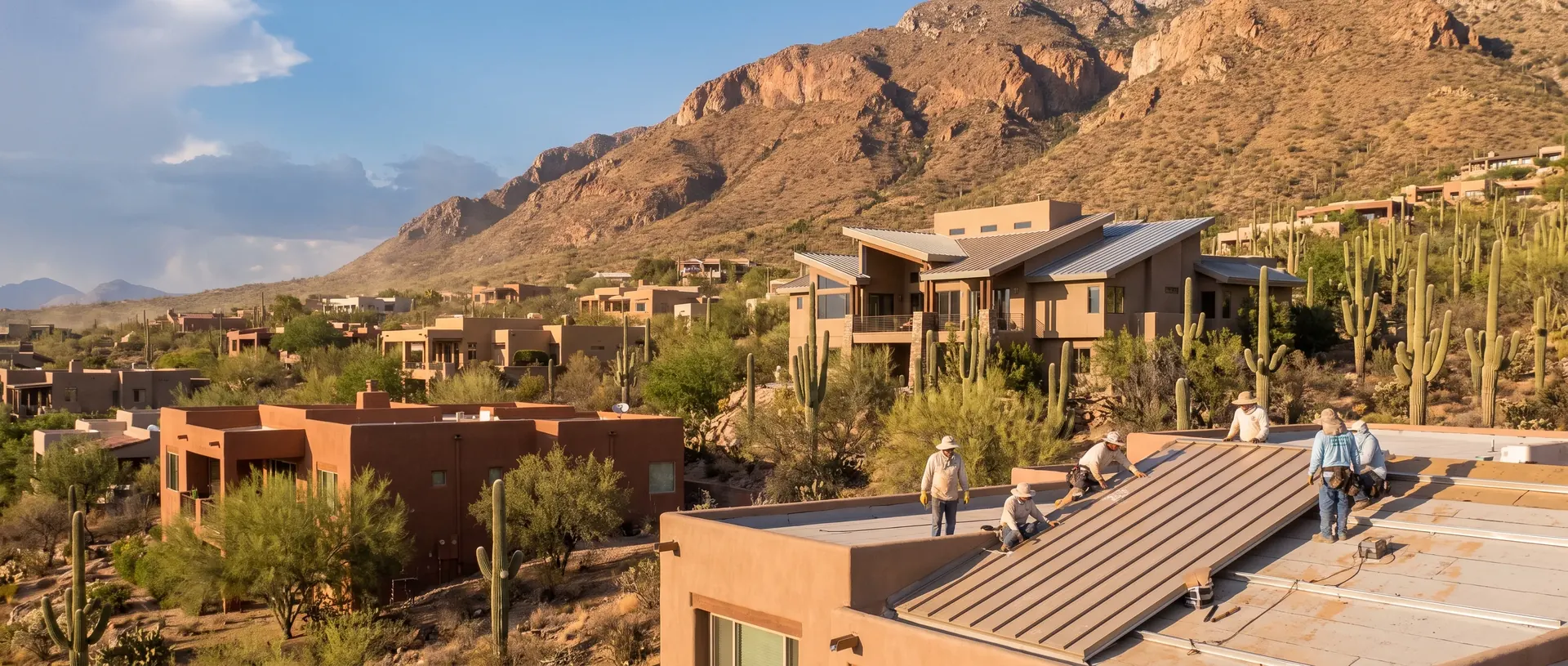
Steep lots, long panel runs and a design review board to satisfy. Metal roof installation, replacement and repair under the west face of the Catalinas.
01Oro Valley, AZ
Oro Valley climbs. It runs from around two thousand six hundred feet up past three thousand as it moves onto the bajada below the Catalinas, and that elevation change does more to a roof than people expect.
The stock is mostly master planned stucco from the 1990s onward, plus a layer of custom homes on steep hillside lots. Those custom houses are where the interesting roofing problems are. Stepped roof planes at several levels, long unbroken runs, parapets, and access that makes staging a real part of the job rather than an afterthought.
Three things separate an Oro Valley roof from one on the valley floor.
The wind is stronger. Air coming down off the Catalina front hits harder than it does in midtown, and it hits panel edges and trim first. Edge detailing that is adequate in the middle of the city is marginal here.
There is a real freeze cycle. Not much of one, and not for long, but a handful of nights a year genuinely drop below freezing at this elevation. That adds a second kind of thermal movement on top of the daily heat cycle, and it is unkind to sealant that is already tired.
And the HOAs are active. Colour, finish and reflectivity are frequently governed here, sometimes tightly. That is not a problem, but it is a step that has to happen before panels get ordered rather than after.
02Services here
03Local conditions
Stronger than the valley floor and consistently directional. It finds edges, trim and any panel end that was not fastened with that in mind.
A long panel expands and contracts more in absolute terms than a short one. On the runs common up here, the movement allowance is not a detail, it is the design.
A few nights a year below freezing is enough to matter, especially where sealant has already been worked hard by summer. It is the one place in our service area where cold is part of the specification.
Many of these communities govern roof colour and finish. Getting approval sorted before ordering avoids the worst outcome, which is a delivered panel in a colour that has to go back.
Next step
We will get on the roof, tell you what it actually needs, and put a written number on paper. If it does not need work yet, that is what the estimate will say.
04Questions
Frequently yes, and increasingly so, but it depends entirely on your community and the rules it operates under. Colour, finish and profile are the things most often governed. We will work to whatever specification your association approves, and the sensible order of operations is approval first, order second.
Buyers here respond to roofs that look appropriate to the house and the setting, which in the foothills usually means desert tones rather than anything bright. Lighter and mid tones also run cooler and show chalking less, so the practical and the aesthetic answers tend to agree. We are not going to attach a value figure to a colour choice.
Yes, and it often works better than the alternatives, because long uninterrupted panels handle a large complicated roof plane well. The real variables on a hillside lot are access and staging rather than the roof system itself, and those get worked out on the site visit.
Enough to matter for a roof. The elevation gain means a handful of genuine freeze nights each year that the valley floor may not see, and cooler nights generally, which widens the daily temperature swing. That is worth accounting for in the sealant and detailing specification.
05Nearby
Tucson down on the valley floor, Marana west along the corridor, and Vail out to the southeast. We also work the Catalina Foothills, Catalina and Sahuarita.
06Get started
Tell us what the roof is doing. We will get on it, look properly, and put the answer in writing. If it does not need work yet, that is what the estimate will say.
Or call(520) 422-4745Mon to Fri, 6am to 3pm. Early hours are not a typo. Summer roofing here starts at first light and comes off the roof around midday.