Fasteners that have walked loose
Backed out screws, spun holes, hardened and cracked washers. The most common metal roof failure in this climate by a wide margin, and the most straightforward to put right.
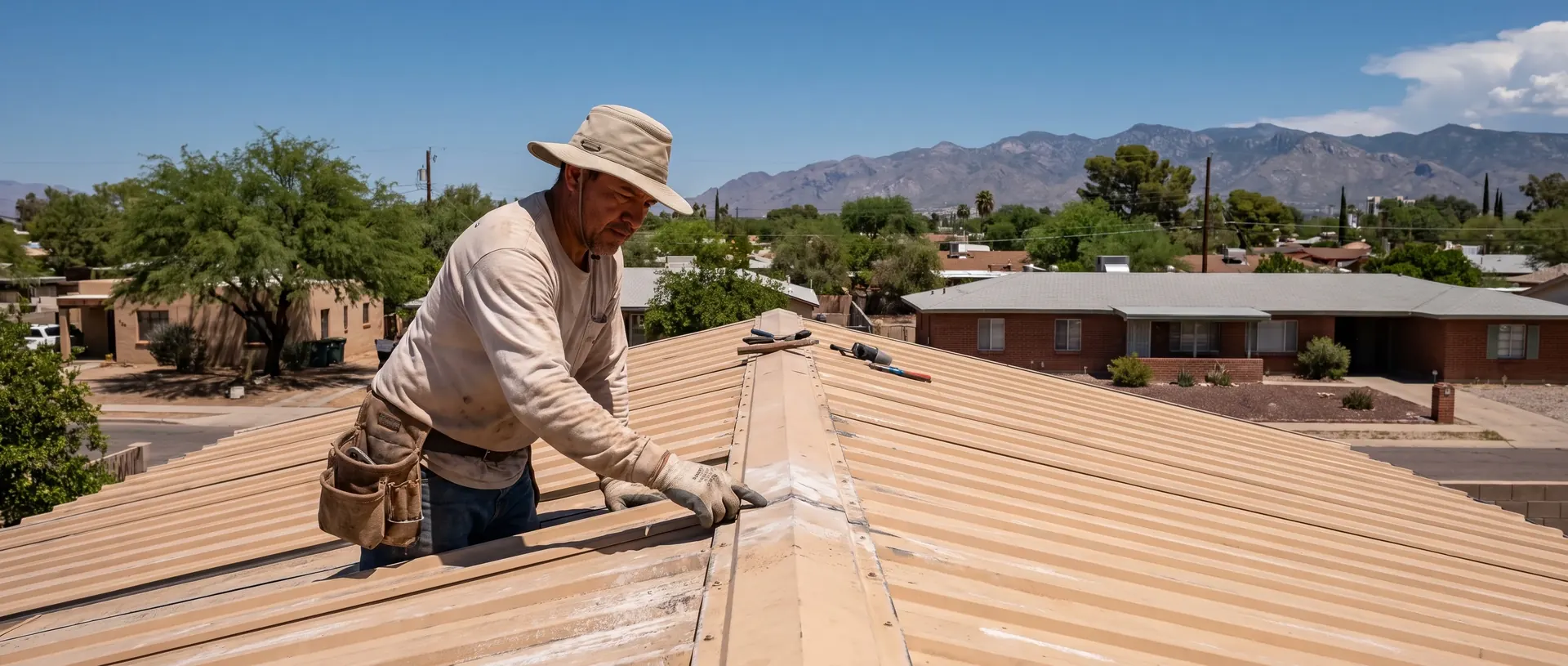
Finding out what is actually wrong before anything gets sealed. Fasteners, seams, flashings and panels on metal roofs across the Tucson metro.
01Core service
Most metal roof repairs in Tucson come down to the same thing, and it is not the metal. The panel is usually fine. What has failed is everything holding the panel down and everything sealing the gaps around it.
Here is why. A metal roof in the Sonoran Desert can swing through a very wide temperature range between four in the morning and three in the afternoon, and it does that every single day. The panel grows and shrinks with every cycle. On an exposed fastener roof, that movement works each screw against its own hole, thousands of times a year, until the hole is slightly larger than the screw. At the same time the ultraviolet is destroying the rubber washer under the screw head, which goes hard, then chalky, then cracks.
Then the monsoon arrives and drives rain uphill against a wall of wind, and it finds every one of those openings at once. That is the classic Tucson call: a roof that was completely dry in June and is leaking in three places in July.
None of that is a defect and none of it means the roof is finished. It means a roof of that type reached the point where the fastener line needs attention. That is a repair, and it is a much smaller number than a replacement.
We work on metal roofs and nothing else. If what you have is tile or foam, we will tell you honestly and point you elsewhere rather than take the job.
02What this solves
Backed out screws, spun holes, hardened and cracked washers. The most common metal roof failure in this climate by a wide margin, and the most straightforward to put right.
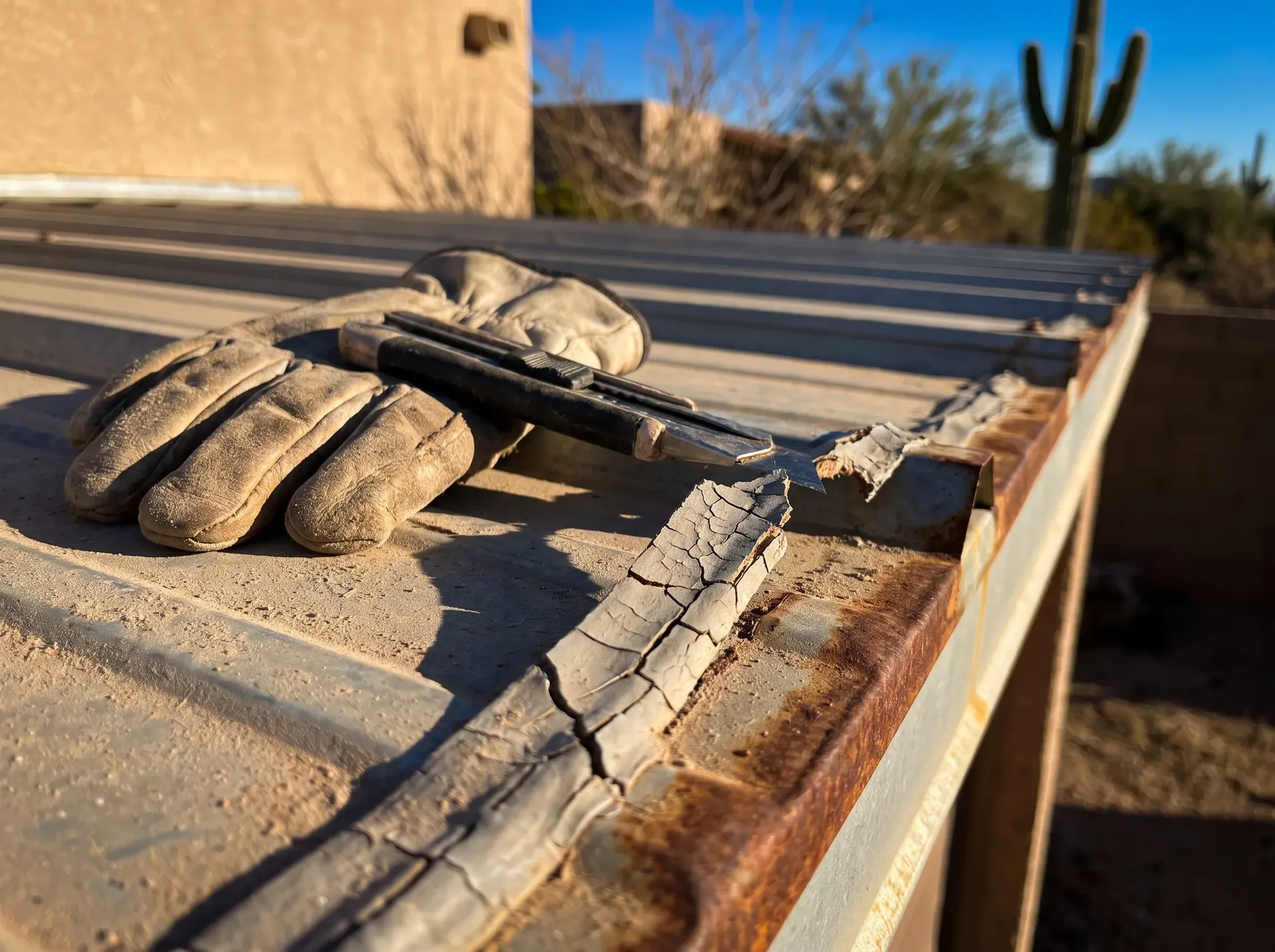
Sealant here does not wear out slowly, it gets cooked. It shrinks, pulls away from one side of the joint, and cracks. Cutting the failed bead out and redoing the detail lasts. Smearing new sealant over old does not.
Where the roof meets a wall, a parapet, a vent stack, a skylight or a swamp cooler curb. Almost every leak we trace is at a detail rather than in the middle of a panel.
03The first visit
Water travels along a panel rib and comes through the ceiling a long way from where it got in. Sealing the wet spot is how a roof gets six repairs and still leaks.
If one screw has backed out in a run, the ones either side of it are usually part way there. Fixing one and leaving the rest means we will both be back in a month.
There is a point where the fastener holes have elongated far enough that repairing is throwing money at a roof that needs replacing. You will hear that from us if it is true.
What we found, what we propose, what it costs and what we are not touching. On paper.
04Our process
We get on the roof and trace the water back to where it actually enters, including checking uphill of the stain. Where there is access below, we look from underneath as well.
Photographs from your roof, of your problem. Not a stock example of what the issue usually looks like.
What gets repaired, what gets left, and what we think will need attention in the next few years. Small repairs get done on the spot where we can, and we will say so rather than booking a second trip.
Old sealant gets cut out rather than covered. Spun fasteners get replaced with a larger diameter that bites fresh metal instead of a wallowed hole. Corroded washers get replaced across the run.
Flashings reformed where they have failed, penetrations reworked, panel sections replaced where the damage is beyond repair.
Including the honest version, which on an older exposed fastener roof is often that this bought you several good years rather than solving it forever.
05Why us
The cheapest repair in the world is the one that fixes the actual leak the first time. Sealing the nearest suspicious thing is how people end up paying three times.
There is a point on an old roof where repair money stops being worth spending. We would rather tell you that and lose the job than take payment for a repair we know will not hold.
Seam mechanics, panel movement and fastener behaviour on a desert roof are the trade here, not an occasional variation on general roofing work.
Next step
We will get on the roof, trace it back to where the water is actually getting in, and tell you what it takes to fix it.
06Proof
We would rather show you a roof than a quote from somebody you have never met. Ask us for an address in your area and go and look at it.
Ask for an address near you07Questions
Fasteners and details, not panels. On an exposed fastener roof it is nearly always the screws: daily thermal movement works them loose and ultraviolet destroys the washers underneath the heads. After that it is failed sealant at seams, and flashing at penetrations, walls, parapets and curbs. A hole in the middle of a panel is rare unless something physically hit it.
Because heavy rain in Tucson does not fall straight down. A monsoon cell drives water sideways and uphill, under panel laps and into details that shed ordinary rain without any trouble. A roof can be genuinely watertight for the light rain that falls the rest of the year and still leak in a July storm. It usually means a lap, a flashing or a fastener line is marginal rather than failed.
Yes, and it repairs better than most materials. Individual panels can be replaced, fastener lines renewed, seams reworked and flashings reformed without touching the rest of the roof. That is one of the real advantages of metal. The limit is the number of times the same holes have been opened up, not the metal itself.
Start uphill of the stain, not at it. Water runs down the underside of a panel or along a rib until something stops it, so the entry point is almost always higher up and often several feet to one side. Check every penetration, the flashing where the roof meets a wall, panel end laps and the fastener line. Where there is attic or ceiling access, looking from underneath during or just after rain tells you far more than looking from on top in the dry.
In an emergency, a proper roofing sealant on a clean dry surface will get you through a storm, and that is a reasonable thing to do at ten at night in July. As a repair it fails, usually within a season here, because the sun destroys the patch and the underlying movement has not changed. The bigger risk is that a smeared repair hides the real entry point and makes the eventual diagnosis harder and more expensive.
Exposed fastener roofs can, and in this climate that is the single most common failure. Daily expansion and contraction works the screw in its hole while ultraviolet hardens and cracks the sealing washer under the head. It is a maintenance item, not a defect. Concealed fastener standing seam roofs have no screws through the surface at all, which is why we recommend them so often on Tucson homes.
Once a year is sensible, and the useful timing here is before monsoon rather than after it, so anything marginal gets caught before it is tested. On an older exposed fastener roof, the fastener line is worth a look every year regardless of whether anything is leaking.
08Service areas
Tucson, Oro Valley, Marana and Vail, and everywhere between them. Sahuarita, Green Valley, the Catalina Foothills, Corona de Tucson, Catalina, Rita Ranch and Three Points.
Areas we serve08Related
09Get started
Tell us what the roof is doing. We will get on it, look properly, and put the answer in writing. If it does not need work yet, that is what the estimate will say.
Or call(520) 422-4745Mon to Fri, 6am to 3pm. Early hours are not a typo. Summer roofing here starts at first light and comes off the roof around midday.