Active leaks during monsoon
Water in the ceiling, a stain spreading, a drip that only appears in a storm. We trace it back to the entry point rather than sealing the wet spot and hoping.
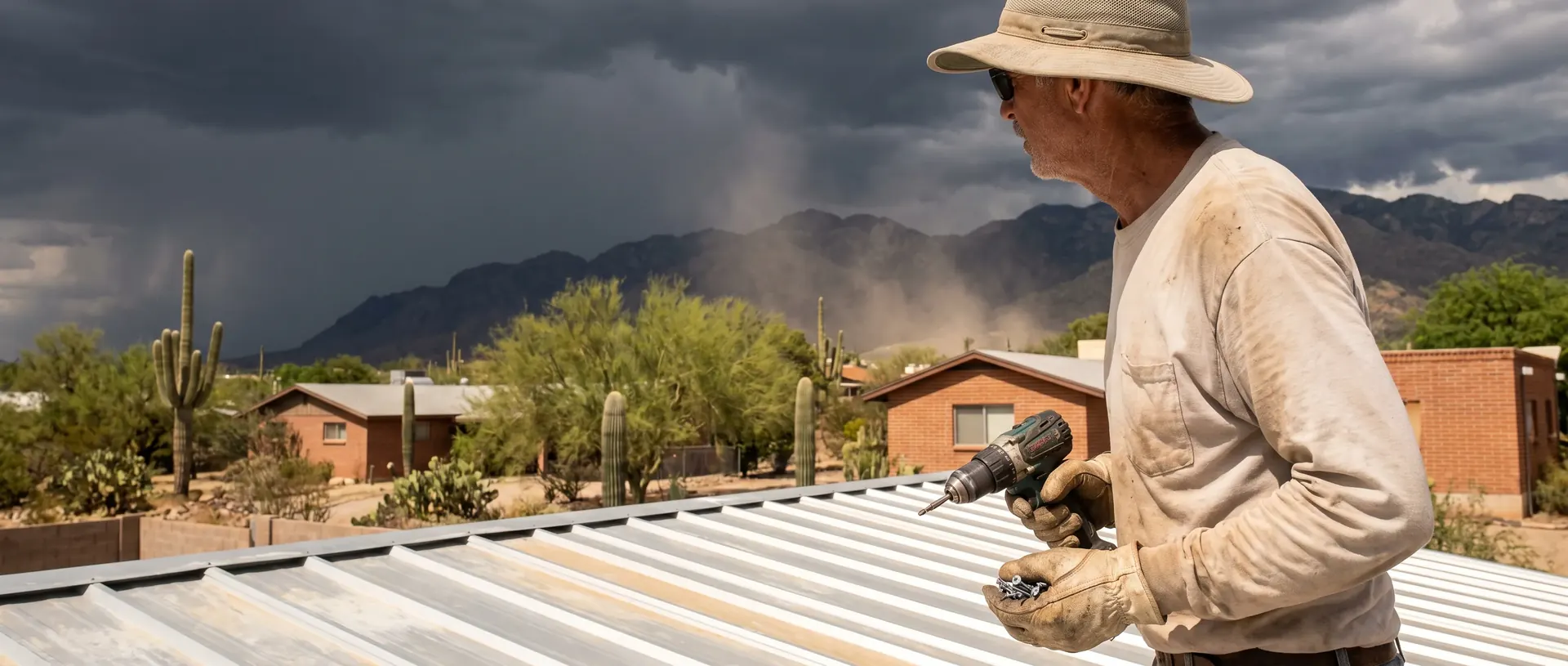
Water coming in, a panel lifted, damage after a cell came through. We trace it, stop it, and tell you what it takes to fix it properly.
If water is coming into the house right now, call rather than fill in the form
Move buckets under it, move what you can out of the way, and do not get on a wet metal roof yourself. It is far more slippery than it looks and people are hurt doing exactly this every monsoon.
01Support service
Tucson gets a large share of its rain in a short, violent window. Monsoon season runs from roughly the start of July into September, and it does not deliver that water gently. A cell arrives with a wall of wind in front of it, drops a great deal of rain in under an hour, and drives it sideways at whatever happens to be facing the storm.
That is a completely different test from ordinary rain. Water is pushed uphill under panel laps, forced into flashings from angles they never see the rest of the year, and driven against wall junctions and parapets with real pressure behind it. Roofs that are genuinely watertight for ten months of the year find out in July that a detail was marginal.
Then there is the wind itself, which lifts panel edges, and the debris it carries, and hail, which turns up more often out toward Vail and the southeast than people expect.
So the pattern is familiar and it catches people out every year. Nothing wrong in June. Three leaks in July. The roof did not suddenly fail. It got tested properly for the first time since last summer.
We work on metal roofs and nothing else. If yours is tile or foam we will tell you straight away rather than take the call.
02What this solves
Water in the ceiling, a stain spreading, a drip that only appears in a storm. We trace it back to the entry point rather than sealing the wet spot and hoping.
Panel edges lifted, fastener lines pulled through, trim and flashing torn loose. Left through the rest of the season, a lifted edge catches the next storm and takes more with it.
Impact damage, dented panels, damaged penetrations and stripped coating. We document what we find properly, which matters if you are going to your insurer.
03The first visit
A sound temporary measure that gets you through the next cell is a legitimate first step. It is not the repair and we will not bill it as one.
Uphill of the stain, along the ribs, at every detail. Storm leaks in particular enter a long way from where they show up inside.
Photographs from your roof. If there is an insurance claim, that record is what it rests on, and it needs to exist before anything gets repaired.
What is emergency work, what is permanent repair, and what is a separate problem the storm simply revealed. Those three are priced separately so you can see what you are paying for.
04Our process
How much water, where, and whether it is still coming in. That decides whether this is today or this week, and we will tell you honestly which one it is.
Where a cell is still moving through or another is forecast, the first job is keeping water out of the building until the roof can be worked on safely and dry.
Proper leak tracing does not happen in a storm at night. It happens once the roof is safe, and it is the step that determines whether the repair works.
Photographs of every finding, so the record exists for you and for an insurer if there is a claim.
Fasteners replaced, seams reworked, flashings reformed, damaged panels replaced. Failed sealant cut out rather than covered.
Whether this was bad luck or a roof approaching the end of its service. Sometimes a storm leak is a storm leak. Sometimes it is the third one this year and it is telling you something.
05Why us
Monsoon brings out people who knock on doors and find damage on every house on the street. We will tell you if what you have is a repair, and most of the time it is.
Photographs of the real findings on your roof, and a written scope that separates emergency work from permanent repair. If you go to your insurer, that is what makes the difference.
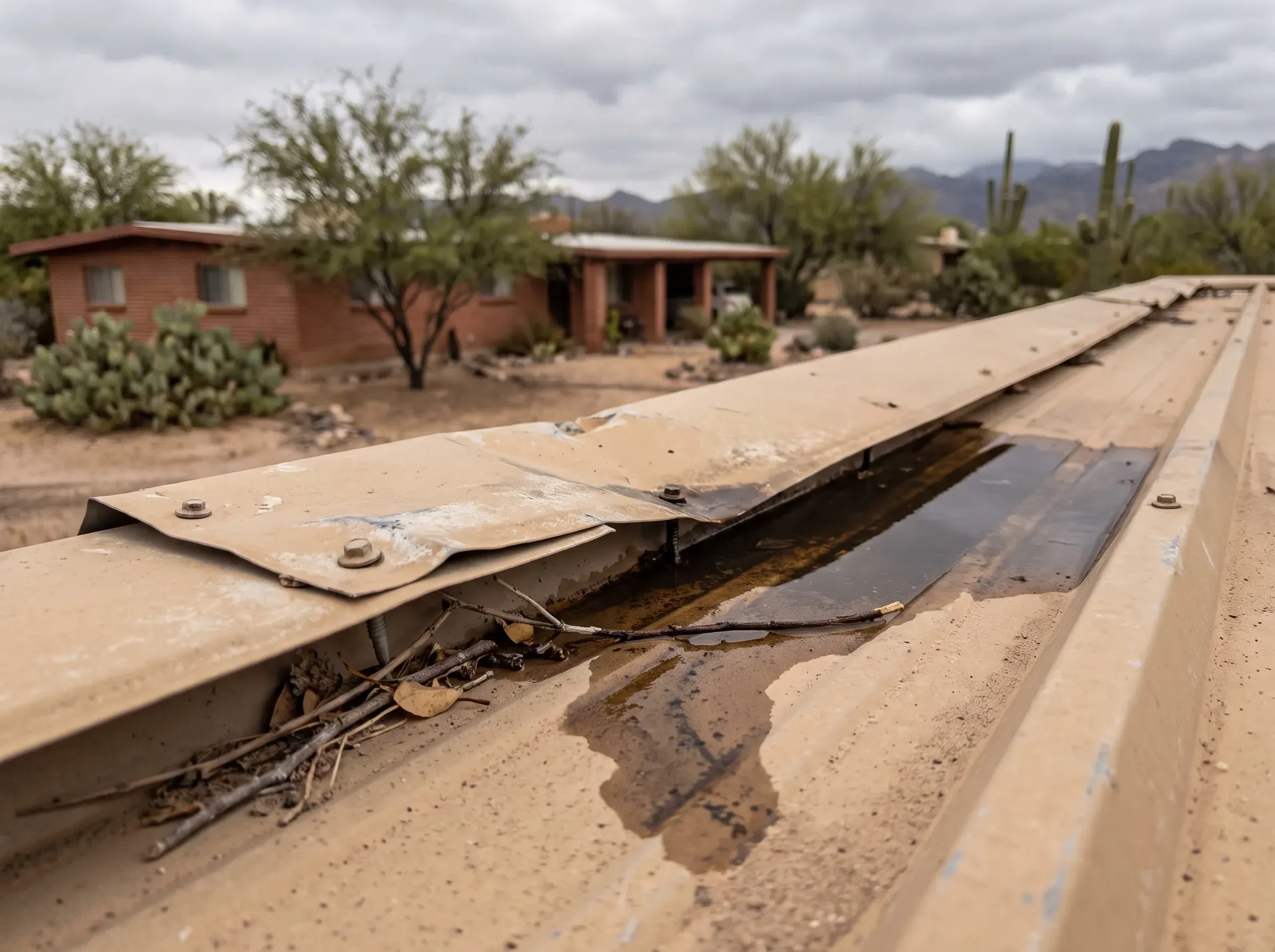
Wind driven water forced uphill under laps. Lifted panel edges. Debris in valleys. Hail out toward the southeast. These are known failure patterns here and we go looking for them rather than being surprised.
Next step
Call and tell us what you are seeing. We will tell you whether it needs somebody today or whether it can wait for dry weather and a proper look.
06Proof
We would rather show you a roof than a quote from somebody you have never met. Ask us for an address in your area and go and look at it.
Ask for an address near you07Questions
The monsoon is generally recognised as running from the middle of June through the end of September, with the storms themselves usually arriving from early July and the heaviest activity through July and August. That is when the great majority of storm roof calls happen. It is also why the useful time to have a roof looked at is May and June, before it gets tested rather than after.
Because monsoon rain does not fall straight down. It is driven sideways and upward by the wind ahead of the cell, so it gets under panel laps and into flashings from directions they never face in ordinary rain. A roof can shed the gentle rain that falls the rest of the year perfectly well and still let water in during a July storm. It normally means a lap, a flashing or a fastener line is marginal rather than gone.
Put something under the water and move furniture and electronics clear. If the ceiling is holding water in a bulge, that weight is a hazard, and puncturing it deliberately in one controlled spot over a bucket is usually better than letting it come down on its own. Photograph everything for your insurer. Do not climb onto a wet metal roof, and do not go into an attic space where water is near wiring.
Storm damage is often covered where wear and tear is not, and that distinction is exactly what an adjuster will be looking at. It depends on your policy and your carrier. What helps your case is documentation of the damage before anybody repairs it, and a written scope that separates storm damage from pre existing condition. We will not tell you what your insurer will decide.
Generally yes, on wind in particular. A properly fastened metal roof has far fewer separate pieces for wind to get under than a shingle roof does, and it does not lose granules to driving rain. Standing seam does better than exposed fastener because there is nothing penetrating the surface. None of that makes a metal roof immune, and a badly detailed metal roof will leak in a storm like anything else.
It can dent one, and hail turns up around Tucson more than people assume, particularly southeast toward Vail and Corona de Tucson. Denting is usually cosmetic and does not affect whether the roof keeps water out. What matters more is impact damage to penetrations, flashings and coating. We look for the functional damage rather than photographing dents.
Call and tell us what you are seeing and we will tell you honestly where you sit in the queue that day. During monsoon season every roofer in Tucson is busy at once, and an honest window is worth more to you than a promise that gets broken.
08Service areas
Tucson, Oro Valley, Marana and Vail, and everywhere between them. Sahuarita, Green Valley, the Catalina Foothills, Corona de Tucson, Catalina, Rita Ranch and Three Points.
Areas we serve08Related
09Get started
Tell us what the roof is doing. We will get on it, look properly, and put the answer in writing. If it does not need work yet, that is what the estimate will say.
Or call(520) 422-4745Mon to Fri, 6am to 3pm. Early hours are not a typo. Summer roofing here starts at first light and comes off the roof around midday.