Tucson is not one kind of house, and the roofing problems track the age of the neighbourhood closely.
Sam Hughes, Blenman Elm and West University are largely 1920s to 1940s brick and adobe bungalows, with low pitched gables and deep eaves built to throw shade before anyone had air conditioning. They are lovely and they are awkward to roof, because the eaves are generous, the details are original, and there is often no attic worth the name to inspect from.
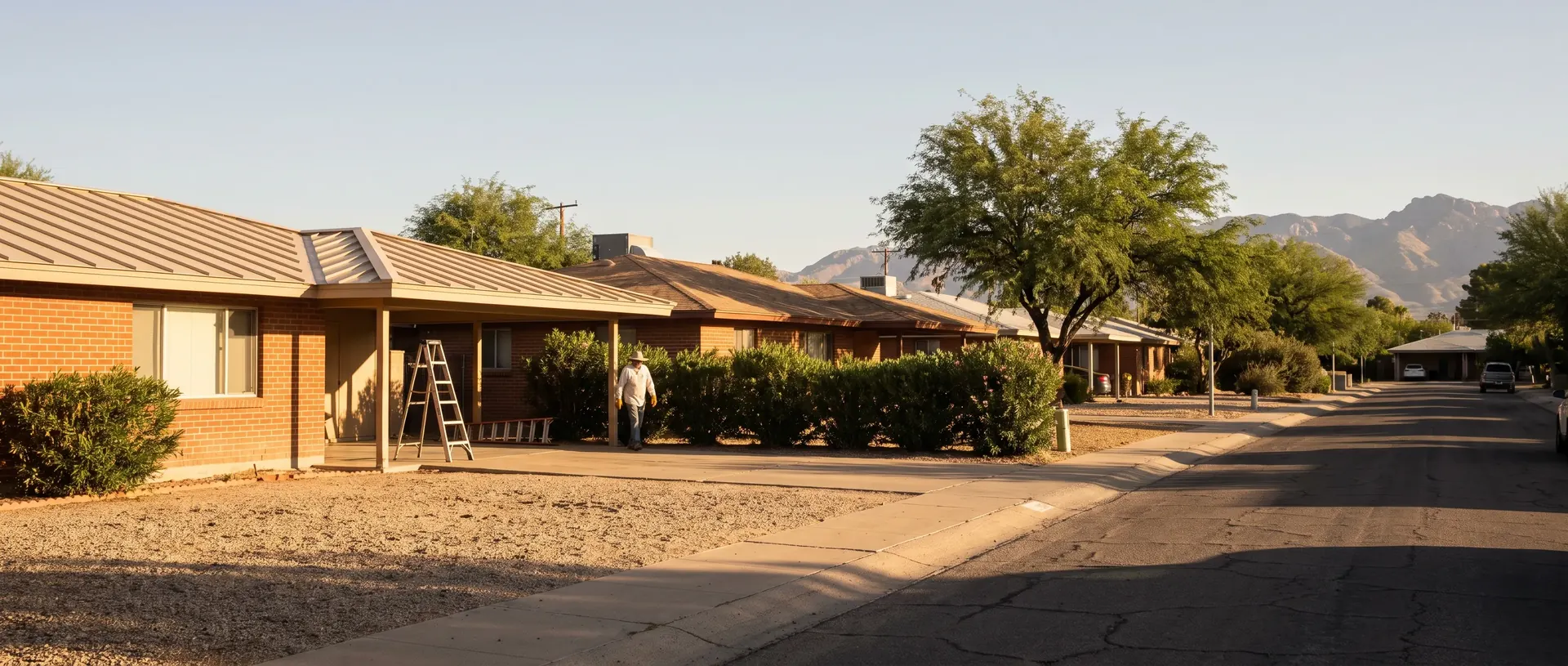
The midtown grid between Broadway and Speedway is where most of our calls come from. Dense 1950s and 1960s red brick ranch, long low slope planes, wide fascia runs, carports, and in a lot of cases a swamp cooler sitting on the roof with a curb around it that has been leaking quietly for a decade. Low slope is the operative detail. Below a certain pitch a lapped exposed fastener panel is simply the wrong system, and a good number of those roofs have one anyway.
Out on the southeast and northwest edges the stock turns to 1990s and 2000s stucco with concrete tile, and those calls are usually somebody who has decided they are finished with tile and wants to know what metal costs.
What all of it shares is the sun. The valley floor sits at around two thousand four hundred feet and takes roughly three hundred and fifty days of it a year. That is what sets the clock on every roof in this city, and it is why an asphalt roof here so often looks finished well before the number on the packet said it would.